In a busy hospitality venue, service speed is not just about having more staff. It is about how quickly information moves between the floor, the bar and the kitchen.
When orders are written down, walked back to a till, rekeyed, printed in the wrong place or delayed during busy periods, small inefficiencies quickly become bigger problems. Drinks take longer to arrive, food orders can be missed, staff spend too much time walking back and forth, and customers feel the delay.
A connected EPOS system changes that.
With ithPOS, orders can be taken directly at the table and sent instantly to the right area of the business. Drinks can go straight to the bar. Food can go straight to the kitchen display screen. Staff can stay on the floor, service keeps moving, and the whole venue becomes more efficient.
A Better Way to Manage Table Service
Imagine a table of customers has just sat down.
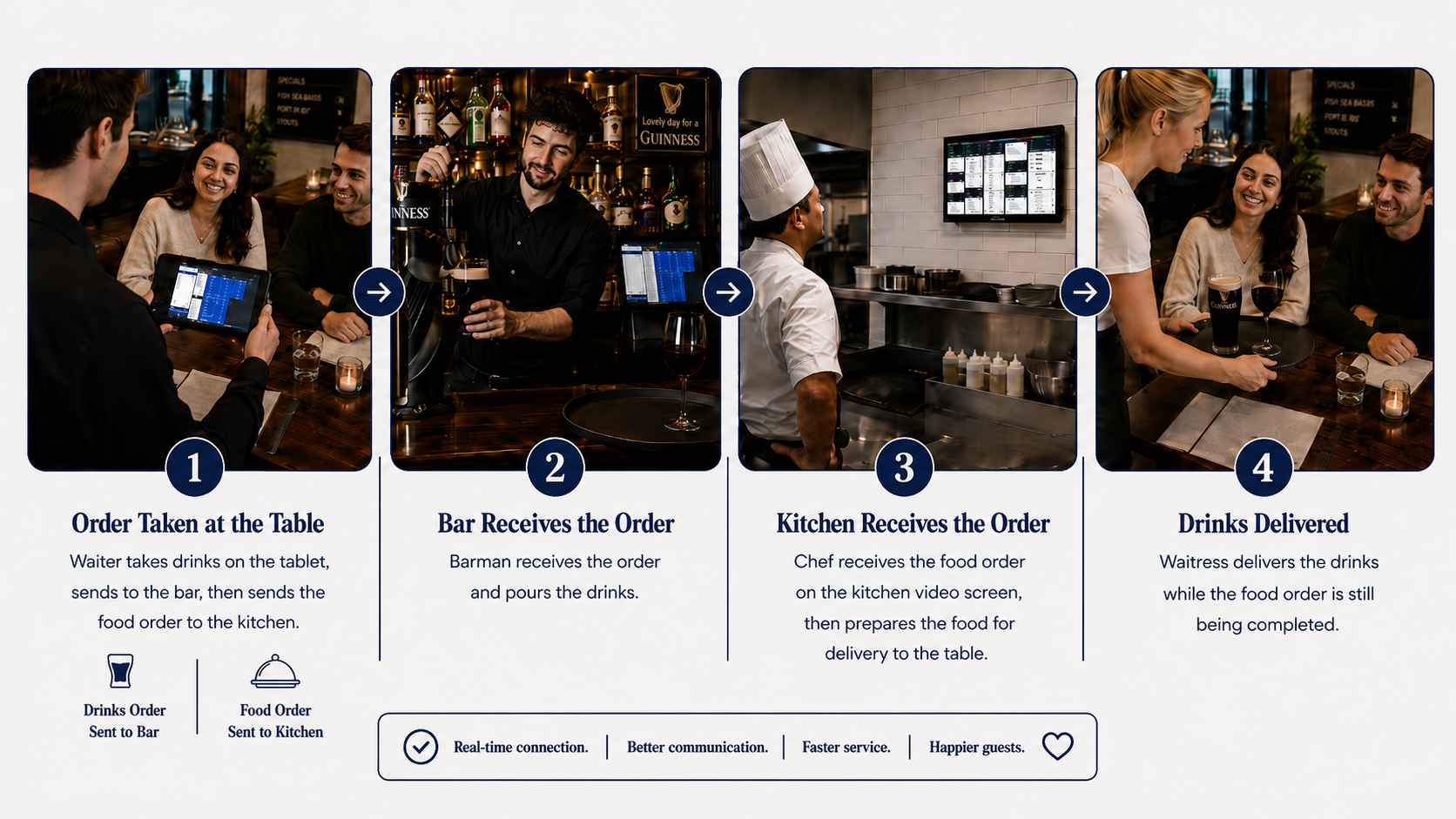
A waiter arrives at the table with a handheld ordering device or tablet. Instead of writing the order on a pad and walking back to a fixed till, the waiter enters the drinks order at the table and sends it directly to the bar.
The bar receives the order instantly. The barman can start pouring the drinks straight away.
While that is happening, the waiter can continue taking the food order from the same table. Starters, mains, modifiers and special requests can be entered at the table and sent directly to the kitchen display screen.
The kitchen team receives the food order clearly and can begin preparing it for service. At the same time, the drinks may already be on their way back to the table.
This creates a smoother flow across the business:
Table → Bar → Kitchen → Table
That simple improvement can make a major difference during busy service.
Why This Workflow Matters
Hospitality businesses rely on timing.
When front-of-house, bar and kitchen teams are not properly connected, service can slow down. Staff may need to return to the till several times. Orders can queue up. Drinks can be delayed. Kitchen teams may not receive clear information quickly enough. Customers may be left waiting, even when staff are working hard.
A connected EPOS workflow helps remove those delays.
By sending orders instantly to the right station, your team can work in parallel rather than in sequence.
That means the bar can start preparing drinks while the waiter is still completing the food order. The kitchen can receive the food order without waiting for someone to walk back to a till. Waiting staff can remain visible on the floor, helping customers instead of moving between stations.
Key Efficiencies This Can Drive
1. Less Walking Back and Forth
Traditional table service often requires staff to walk from the table to the till, enter the order, return to the table, check details, and then continue service.
With handheld ordering, staff can take the order once and send it instantly.
This reduces unnecessary movement and gives staff more time with customers.
2. Faster Drinks Service
Drinks are often the first thing customers notice.
If a drinks order is delayed, the whole experience can feel slow from the beginning. Sending drinks directly from the table to the bar helps the bar team start work immediately.
This is especially useful in pubs, restaurants, hotels and busy cafés where drinks service needs to move quickly.
3. Better Communication with the Kitchen
Kitchen display systems help reduce confusion by showing orders clearly on screen.
Food orders can be sent directly to the kitchen, including notes, modifiers and course information. This gives the kitchen team better visibility and helps reduce the risk of missed items or unclear handwriting.
For restaurants and food-led pubs, this can improve both speed and accuracy.
4. Fewer Manual Errors
Manual rekeying creates risk.
If an order is written down and then entered later, details can be missed. If staff have to type amounts manually into payment terminals, further errors can happen.
A connected EPOS setup helps reduce those risks by capturing the order at the source and sending it digitally through the system.
5. Better Use of Staff Time
Labour is one of the biggest pressures in hospitality.
The goal is not always to reduce staff numbers. Often, the goal is to help existing staff do more with less friction.
When staff spend less time walking to tills, chasing dockets or clarifying orders, they can spend more time serving customers, upselling, clearing tables and improving the guest experience.
6. A Smoother Customer Experience
Customers may not notice the technology behind the scenes, but they notice the result.
They notice when drinks arrive quickly.
They notice when orders are correct.
They notice when staff are present and attentive.
They notice when service feels organised.
A connected EPOS system helps create that smoother experience.
From Disconnected Service to Real-Time Service
Many venues still operate with disconnected systems.
The till sits in one place. The card machine works separately. Orders are printed in one location. Kitchen communication depends on paper dockets. Staff have to move constantly between customers, tills, bar and kitchen.
ithPOS brings these workflows together.
With handheld ordering, integrated payments, bar printing and kitchen display systems, your venue can operate in real time. Orders move instantly to the right place. Staff stay informed. Management gets clearer reporting. Customers get better service.
Ideal for Restaurants, Pubs, Cafés and Hotels
This type of workflow is useful across hospitality.
For restaurants, it supports table service, course management, kitchen communication and smoother ordering.
For pubs and bars, it helps with drinks orders, table service, bar tabs, food orders and faster service during busy periods.
For cafés, it can improve order accuracy, speed up counter and table service, and support food preparation workflows.
For hotels, it can support restaurant, bar and room service operations, while helping teams manage multiple service areas more efficiently.
Why ithPOS
ithPOS provides hospitality EPOS and payment solutions designed for real trading environments.
Our systems can support:
- table ordering
- handheld ordering
- bar printing
- kitchen display screens
- integrated card payments
- pay at table
- reporting
- hospitality-specific workflows
The aim is simple: help your business serve faster, reduce mistakes and improve the way your team works together.
A Connected Venue Runs Better
The best hospitality technology should not get in the way of service. It should make service easier.
When a waiter can take a drinks order at the table, send it to the bar, continue with the food order, and have that food order appear in the kitchen in real time, your venue becomes more efficient.
The bar works faster.
The kitchen gets clearer orders.
The floor team stays with the customer.
The customer gets a better experience.
That is the value of connected EPOS.
Book a Demo with ithPOS
If your restaurant, pub, café or hotel is still relying on disconnected tills, manual card machines or paper-heavy order workflows, ithPOS can help.
We provide modern hospitality EPOS and integrated payment solutions for Irish businesses, helping you connect your floor, bar and kitchen in one smoother system.
Book a free demo today and see how ithPOS can help your venue serve faster, reduce errors and run more efficiently.